After relaxing in the hills of Bali for a few days, it was time to set off in order to fit in all the sights in Java and Sumatra. This made for a long day of travel to the neighbouring island; first back to Denpasar (near Kuta) and then transfer to another bus terminal before getting a bus Gilimanuk (west Bali) bound, about a five hour ride, followed by a ferry crossing. Not so much long as it was boring, but happy enough to get to Java and find a cheap as chips guesthouse to relax in, until midnight at least.
As always, there is someone willing to help you find accommodation or book a tour with and this small town of Ketapang was no exception. Four pound accommodation, okay. Reduced price volcano trip, excellent. Even approaching high season, some of the sights out here fall victim to the popularity of the Komodo dragons on the Flores islands and the obvious delights of Bali.
Mt. Ijen
This is just one of many volcanoes in Indonesia but a popular one on the tourist trail, mainly because of the lake in the Ijen crater, the blue fire which can be seen at night, and the miners working to excavate as much sulfur as they can in a day.
Still feeling groggy from waking at just after midnight, the driver spent just under two hours driving to the base of the trail leading up to the lake, the four-by-four slowly trudging uphill over the cobbled road. Once at the top, the rangers offered coffee and a simple breakfast before the assault on the path to the top. Not the most rigorous climb but still, thankful for a headlamp and at 3am it was difficult enough.
Reaching the cusp of the caldera around 4am, the miners were all out in force, labouring up the hill with their baskets of sulphur which weigh somewhere between 75 and 90kg. They have to climb up out of the crater and then 3km down to get it weighed, twice daily, so they can be paid, about $10 a day. Yikes.
The blue flame, which you can only see at night, was really cool, basically super hot fire coming out of the ground with the sulphur pouring out around it. Meanwhile the miners were working around these conditions. Soon enough the sun started to come out, the fire disappeared and you could see just how yellow the area is where the sulphur rises. Given the conditions, the miners have to stop around midday, hence the early morning starts, as the entire lake is just covered by fumes.
 |
| Ijen Lake |
 |
| At about 2800m elevation, it was pretty cold up here early morning |
 |
| Miners at work |
 |
| Doesn't look too heavy |
 |
| Surface of the caldera |
Mt. Bromo
Five hours west of Ketapang lies the small town of Probollinggo, the jumping off point for any and all tours heading to Mt. Bromo, the ultimate volcano sunrise in Java, or so it is said. Not enough time to enjoy sunrise at every peak so just went with the flow and sorted out another tour. No guide needed this time as with Ijen, a jeep makes things easier but it's not necessarily required to get to the viewpoints from where you wait for the sunrise. Those who wish to can hike up to the viewpoints from the local village Cemero Lawang, but back-to-back midnight starts didn't sound particularly appealing.
There are two viewpoints and from the lower one I assume you have just as good a view as the higher one, the distance to the volcanoes making the difference between the vantage points minimal. Thankfully a much later start to proceedings, only had to get up at 2.30am this time, and even though it was at a similar altitude to Ijen, it wasn't so cold with the cover afforded from the viewpoint.
Mount Bromo isn't actually the biggest volcano in the massif, but it is the most well known, having erupted as recently as 2011. In the picture below, Mount Batok is in the foreground, Mount Semeru in the background and Mount Bromo in the middle with the 'Sea of Sand' surrounding them.
 |
| Sunrise |
 |
| Mt. Bromo et al |
Jogjakarta
Ten hours drive west of Bromo is the town of Jogjakarta, home to two of the most famous temple complexes in Indonesia; Borobudur and Prambanan. There are plenty more options available, more volcano tours and jungle treks for those interested but having just done this, I took a pass.
Not a whole lot going in the town itself, the city's kraton being the main attraction within the city, but this isn't necessarily a tourist attraction, more like some sultan's home, or so I was led to believe. Anyway, not here for that.
Borobudur
Close to a couple volcanoes, of course, and just 40km or so outside of town lies Borobudur, the biggest Buddhist monument in the world. It's a pretty big complex but you only really come out here to see the main temple. As usual here, the easiest thing is to book a tour with anyone on the main tourist road and you can arrange hotel pickup and transportation to the temples. Both Borobudur and Prambanan came as a package deal for around a fiver, can't go wrong (excludes entrance fee, looking at a tenner for both).
From the main entrance you can't actually see the temple but once you have walked through the garden for a minute or so, the main temple looms up close in a big section which it dominates. There are three levels but to beat the crowds the easiest thing to do is go straight to the top for some choice snaps and work your way down. Even on a Saturday, the number of kids on school trips was staggering. One group came up to us for a photo and when we said it was okay, the flood gates opened and the next hour was literally spent posing with every kid in Java, my mouth was aching from smiling.
 |
| At the base of the temple |
 |
| Surrounded by shrines |
 |
| Stupas on top with Buddha statues inside |
 |
| View from the top |
 |
| View from below |
Prambanan
An hour or so away from Borobudur but closer to the city lies Prambanan, the largest Hindu temple in Indonesia. Unlike the previous temple, once you are past the ticket office and round the first corner, the temple is in full view and dwarfs everything else in the surrounding landscape. The main shrine, dedicated to Shiva is nearly fifty metres tall and the obvious centrepiece to the temple. Many of the smaller shrines hold statues or various deities and you can walk up the steps to go into them all, aside from the one which is being renovated.
Not as many school kids thankfully and only accosted a handful of times which I could manage, any more though and I may have lost the will to live.
The grounds were a similar size to Borobudur but what remaining temples there were, were all under repair so not too much to see there unfortunately, so after walking around the main attraction it was time to head back to the hotel.
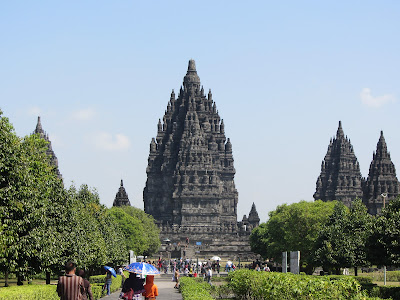 |
| Temple from afar with the main shrine dedicated to Shiva |
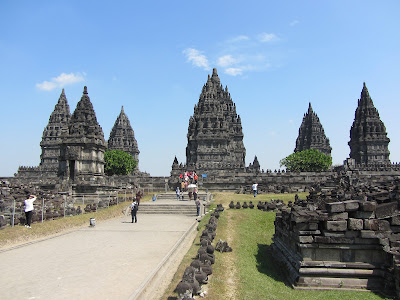 |
| Walking up to the temple |
 |
| Posing |
 |
| Nice leap |
 |
| Temple under repair |
|
|
|
|
Jogjakarta itself was a relexing city, or it could have been. The hotel had a balcony with an epic breeze in the heat of Indonesia. Either way, after the early morning starts to see the volcanoes and temples, it was a nice place to rest and recharge the batteries.
Not feeling Jakarta, been to big cities before and not overly bothered about it so plane tickets booked and heading straight to Medan on Sumatra to get to Lake Toba, a place I have always wanted to get to. Not overly interested in 40 plus hours on a bus, a couple quick flights will be just fine. Next stop, Lake Toba.