Showing posts with label Bolivia. Show all posts

Wednesday, 8 May 2013

Copacabana and Lake Titicaca, Bolivia

Just three hours away from La Paz on the border of Peru lies the small town of Copacabana, the gateway to Lake Titicaca, the highest (inhabited) lake in the world, and the islands that populate this water mass, namely the Isla del Sol; Sun Island.

The journey from La Paz is beautiful with the bus driving through the El Alto area at around 3600m before coming to a river where you then have to get off the bus and take a boat to the other side, the bus meanwhile is loaded onto a two vehicle barge and slowly makes it's way over. Once on the other side the bus heads to Copacabana on a winding route with Lake Titicaca always on the right hand side. Eventually the town itself comes into view and the famous two prong hill in the centre of town dominates the landscape with the lake in the background and the mountains to the north east.

The town is small and besides the calm and tranquil beachfront with it's sunset view cafes and rows of stalls selling fresh trout from the lake (delicious), there isn't too much on offer in town, just the usual hotels, hostels, restaurants and shops selling endless alpaca.

Lake Titicaca is the main draw here and the Isla del Sol in particular. There are several options for investigating the island and the surrounding floating islands nearby. It's possible to stay on the island itself and give a little back to this remote community, or another option is to just do a day trip to get a feel for the island. Been a little strapped for time having spent way too long in La Paz, I went for the day trip option.

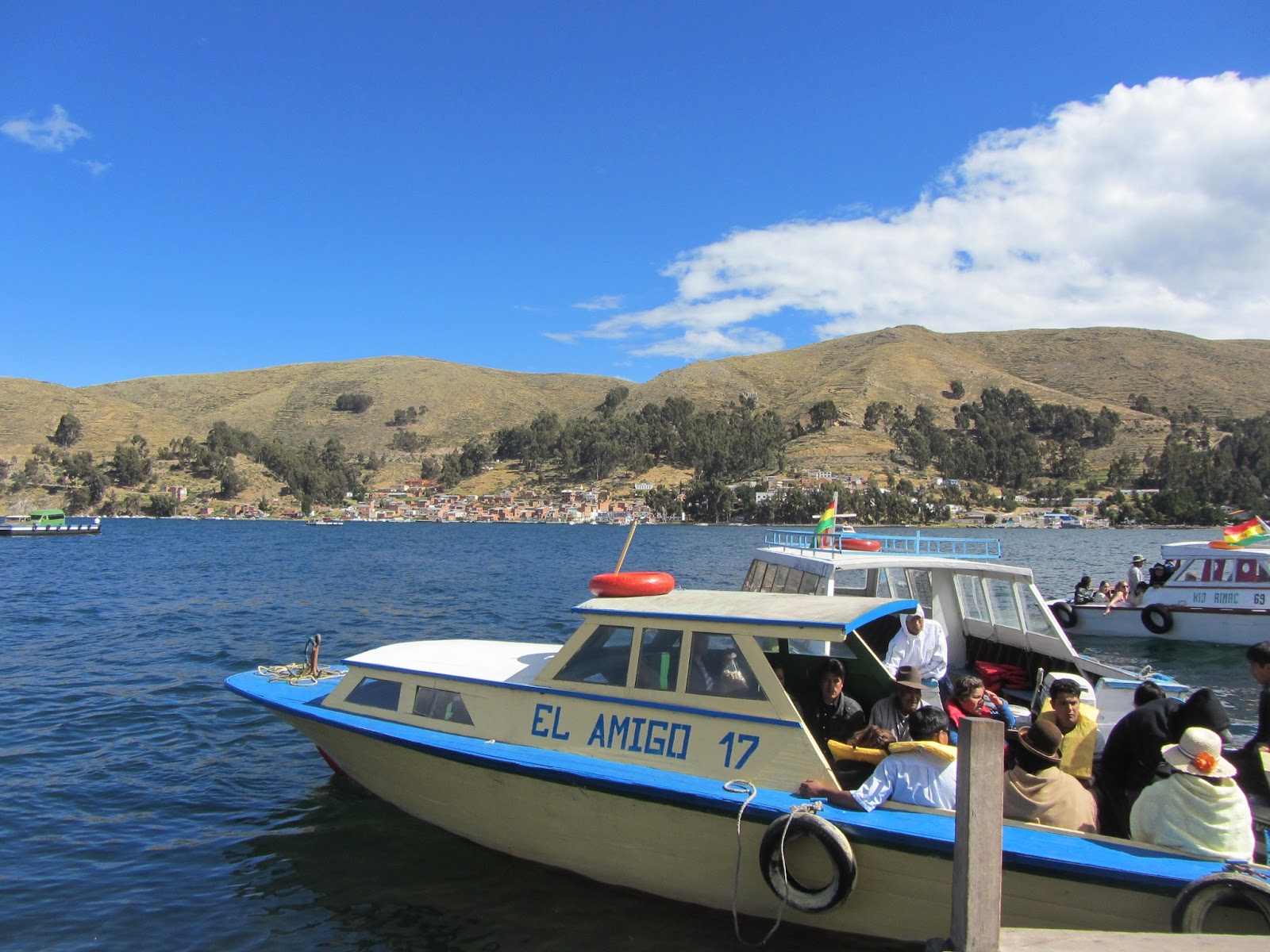
Buying tickets is easy, there are numerous touts offering return tickets and at the 'marina' there are a couple shacks which run different boats running to the island. By and large you want to start early and get a ticket to the north port of Sun Island in the morning, as this then gives you a chance to walk across the spine of the island to the south port just in time for the boats heading back to Copacabana in the afternoon.

The boat ride to the north port takes around two and half hours so make sure you bring a top for this part as it gets cold as you zip along the lake, most people on the top deck looked frozen and pretty miserable. From the port, you have to walk along the beach and then cut inland to another beach, from here there is a path which then leads to the Chicana ruins, this takes around 45 minutes and is progressively uphill. Once at the ruins, I won't lie, you don't quite realise you have reached what it was you were looking for. I was expecting some ancient Inca ruins or something a little more spectacular considering how much people bigged this place up, it basically looked like a barn and outhouse after a bad storm had taken away the roof. Lamest ruins I think I will ever see.

After this minor disappointment it was a two hour walk along a very well laid out path to the other side of the island. Again there is a steady incline for most of the way with the ascent lacking in anything beyond arid looking landscape and wonderful views out over the lake. Come the point where you start to descend, trees pop up out of nowhere, there are fields and farms been tended by locals and hostels and restaurants spring up as you reach the village of Yumani, home to the south port. A quick bite to eat and then only a one and a half hour boat ride takes you back to Copacabana just in time to enjoy sunset and some fresh grilled seafood by the lake.
Copacabana from afar


Approaching Copacabana

Beachfront

Of they have swan paddle boats

It doesn't get much fresher

Closing in on the north port

On the way to the ruins

Somewhat underwhelming


Clear path to follow


Random checkpoints for tickets and snacks

Yumani on the horizon

South port at Yumani
Downtown Copacabana


Sunday, 5 May 2013

A visit to the Cooperative mines in Potosi, Bolivia

At one stage, Potosi was the richest city in the whole of South America, with an outlandish amount of silver on offer, the Spanish mined the area until it was pretty much exhausted. Now, there are remnants of a city rich in history but by and large it's time has come and gone. Mining still continues in what is the deemed the highest city in the world at 4070m. Conditions are harsh and it's normal for miners to have a shelf life of only another 10 years once they start working in the mines, however many people in this poor area have no choice but to work here.

Even though the mines are still in use, tours are available to see just how difficult life is for the miners. Prices are around 100 Bolivianos which is very cheap and half of the money is given to the miners so you know you're supporting a good cause.

Tours start with pick up and then you are taken to get yourself kitted out in overalls, boots, helmet and flash light. Temperatures increase pretty quickly in the mines with the fourth and fifth levels comfortably getting up to 40 degrees so there's no need to wear too much under the clothes you are given.

Once decked out in your new garb you are taken to the miners market where you buy 'gifts' for the miners who are working that day. These generally include coca leaves,water, fizzy drinks and dynamite. Yes, you can go to the local market and get your hands on some dynamite.

From here the bus drives up towards Cerro Rico, Rich Hill, which is where the mining takes place. On the way you get great panoramic views of the city and stop via the processing plant where the zinc and silver (today's more mined elements) are extracted from the rock.

Once at the top of Rich Hill, the jeep is greeted by dogs, we get another quick safety brief and we turn our lights on, I can't stress enough how indispensable the helmet and light were. Without them you'd happily be nursing a concussion as the tunnels get seriously narrow and at stages you have to crawl through them.

The first couple of levels are harmless enough, if you will, but descending into the lower levels it becomes hotter and the lack of oxygen becomes more apparent with dust particles circling around you and breath harder to come by. Wearing a thin scarf across your mouth helps but you still have to fight for breath the further down you go, I've no idea how the miners who work in here day in, day out survive this place a week, let alone ten years.

Down on the fifth level, our group encounters our first miners who are busy at work. They have two tonnes of rock to shift: using only a shovel, they move the rock into a gourd shaped container which when full, is hoisted up to one of the upper levels to be transported to the surface in a similar fashion, or so I assume. The men are thankful for our presence, it gives them a small amount of respite from their work as they get to replenish their supplies from our gifts and the lads in the group have a go at shovelling the rock. It's hard work, just filling one of the gourds takes only a minute or so, but once that one is lifted away, there is another one waiting to be filled right there and then. It's back breaking work, hats off to these men who do this on nothing but water, pop and coca leaves, which not only gives them energy as they don't eat while on shift, but also acts as an indicator of time; once the leaves lose flavour, it's time for a break.

After a while it's time to leave the miners to their work and visit the 'museum', this is in actual fact more of a shrine to El Tio, basically if you leave coca leaves, alcohol or a foetal llama in some cases as offerings, then you are more likely to get good hauls of elements. The men here are so superstitious that women are not allowed in the mines, and only recently did they stop complaining about female tourists visiting.

Following on from here, the group is taken out of the mines via a different access route, but not before handing out some dynamite to some miners intent on causing some destruction and finding some fruitful rock. Unfortunately they are a little over the top with their safety so when the explosion actually happened, it sounded more like a far off fart. Still, better than getting yourself blown up.

Toward the end of the tunnel, the air becomes clearer and you can feel the wind picking up as you near the exit until the end is in sight as a tiny glimmer of light becomes bigger and bigger. Even at 4070m, the air feels fresh and loaded with oxygen and everyone takes a deep breath before been taken back to the city to clean up.


Wednesday, 1 May 2013

Mount Huayna Potosi, La Paz: Attempting a 6000m mountain

Situated about 25km north of La Paz is Huayna Potosi, a 6088m mountain in the Cordillera Real, one of the more popular options to try and scale a 6000m plus mountain. There are plenty of tour agencies in La Paz that offer trips to the summit: three day/two night and two day /one night summit assaults. My choice was to end up being my downfall.

I went for the shorter option, purely because I thought I could handle the altitude and manage it in a shorter time. La Paz is some 3600m above sea level so I am already slightly acclimatised but you really need to do the three day tour as it gives you an extra day to acclimatise at 5200m. Should have known this, wasn't thinking straight though, probably the altitude.

Once you are picked up at the hostel you are driven up to the El Alto area toward the mountain where you are dropped off at around 4800m. This stage of the trek requires you to carry your pack with all the necessary cold weather gear that will be required for the second stage. After crossing a river the trail angles towards the face of the mountain and after paying a 10 Boliviano entry fee the final hour or so is a steep assault up the rock face and scrambling over lose rocks. Once this section is over, you have reached the upper base camp at 5130m where a hot meal and rest is to be had.


Getting up at midnight to start the assault of the peak is not my idea of fun, having been sent to bed at 5pm you have seven hours of rest after dinner. The problem here is I couldn't sleep, when was the last time you went to bed at 5pm? Therefore, after squirming around in the dark, cold attic with 20 other people, we were up and getting ourselves suited and booted. Temperatures get as low as -15 around the top so it was important to dress appropriately, this included the following: two pairs of socks, snow/walking boots, crampons, thermals, trekking pants, plenty of upper body layers, cold weather pants and jacket, hat, scarf, helmet and ice axe. Quite the load.

As soon as you walk out of the building you realise that all the gear you have on is not overkill and that you'll need every last stitch of clothing you have as it is only going to get colder the higher you get. Although I hadn't slept and breakfast was a measly portion of bread and jam, I felt pretty good and thought I had a good chance of reaching the top. With a success rate of 60%, I was hoping I was capable of getting there.

Once the crampons are on, it is pretty much straight uphill with the gradient never letting up, not a bit of level ground to catch your breath at all. People are paired up with a guide and roped together in case someone falls. Groups are never more than three as it is only possible to fit three on the very peak of the mountain, small groups also ensures a higher safety rate, or so I assume.

Pretty soon after starting I realised this was going to be difficult, who was I kidding. I have one sober evening in three months and think I am prepared for a 6000m mountain, not the most prudent planning. By the time my group reached 5400m, I was seriously struggling to breathe and my body was not moving very fast, it wasn't long before my partner transferred to a less infirm group. I refused to give up though, and carried on until the hardest part which is basically a section that has a ridiculous 60 degree angle (the guide said 45 but I refuse to believe that for one second so I will happily exaggerate). I was literally hyperventilating and putting every last bit of strength into every attempt at getting my axe into the ice wall, it may have been only a hundred metres or so of ice but without a doubt the most difficult physical thing I can ever remember doing.

As soon as you crest this section the wind hits you, a repetitive wet slap in the face as by this stage there is hail coming in at the most obnoxious angle and your body is just been buffeted by the wind as you are out in the open. I knew I was on my last legs by this stage but refused to quit mentally, however, it wasn't long til my body had had enough and I literally sank to my knees and braced myself with the axe at 5725m. All this time my guide had been giving me words of encouragement and never once suggested turning around, a real trouper, but I bet he was only more than relieved when I said I had to turn back.

Getting back was just as difficult as getting to where my body capitulated, don't let that downhill gradient fool you. First of all, I had to navigate that 60, maybe even 70 degree section again, only this time I couldn't see anything below me which was a bit scary considering I was completely void of all energy. Next came the slow slog down the mountain face which was excruciatingly slow as I had to slop every couple steps just to get my breath back, I really couldn't breathe at all by this stage.

By the time I reached the bottom, even taking my crampons off left me close to fainting, all I wanted to do was pass out somewhere and catch my breath.. However, once inside the base camp, a cup of coca tea and a hot bowl of soup restored some pallor to my cheeks and by the time other people stumbled in I could almost string a sentence together without pausing for breath, thankfully I wasn't the only one who didn't make it, but hats off to those who did.


In hindsight, the two day/one night trip was always a bad idea as it really didn't leave me with enough time to acclimatise and I should have known this considering last year I fell apart at 4900m in India. The smart money would be on doing the three day/two night hike instead. This allows your body time to recover from the initial walk up to base camp and additional time to get  your body used to the increased elevation. This is one of the easier 6000m mountain's to summit, and with a bit more cop on I feel I could have been successful, unfortunately not this time round. Perhaps next time.