Heading up towards the north of Peru there isn't much on the radar for tourists until you come across the small village of Mancora, which is just a couple of hours away from the Peru - Ecuador border. What started off as just a small fishing village has grown to be a hub for those keen on finding some surf along the Pacific coastline, with decent enough waves for most of the year and with it being so windy, kite surfing is now becoming increasingly popular here.
When driving through the town itself, you wouldn't think there was much to see or do as it looks like it has been catered only for tourists with the main road packed with Internet cafes, restaurants, bars and shops selling all the usual junk. However, once you get off the main road and start heading west to the beach through the 'suburbs' you see that underneath this tourist facade lies a town like any other in Peru, with locals trading between one another, kids running around after dogs, shop owners standing outside their stores with the apparent air of not being bothered about selling anything all day, police chatting to locals and the daily chorus of singing from churches.
Accommodation is spread out all over the place here and with so many options you would be doing something wrong if you couldn't find somewhere you liked. All budgets are catered for as well as lodgings which range from dorms in party hostels to beach front bungalows. Food is fresh from the ocean, so much so you shouldn't be surprised to find some sand in half your meals, having said that though, if you like fresh seafood it doesn't get much fresher than here.
The beach itself is clean enough with fires been prohibited and most people spending the day either lounging on the sand or trying to catch that elusive wave. Parties abound every night with the weekends been the busiest as with any place, at this time the bars on the beach come to life with outrageous happy hour deals whilst trying to out do one another to see who can be the loudest. It's safe to say that there is always a random party a short taxi ride away if the constant competing for airspace starts to get old. Failing that, if it's peace and tranquillity you came here for, then it is just as easy to immerse yourself in the silence of a well secluded bungalow by the beach.
Getting here is ridiculously easy, the main street is the main road from Lima up north to the border with Ecuador, you basically can't miss it, I think it's the Pan-American Highway actually. If you have the time, it's a nice place to stop off to party/ relax/ surf or all of the above. The weather here is pretty much always perfect and compared to the temperamental weather of Ecuador, if it's beach time you are after, this might just be the place for you.
Showing posts with label Peru. Show all posts
Thursday, 27 June 2013
Mancora, Peru
Labels:
beach,
blog,
bungalow,
Grattan Maslin,
Mancora,
Peru,
solo,
South America,
surfing,
travel,
travel blog
Friday, 24 May 2013
Colca Canyon, Arequipa
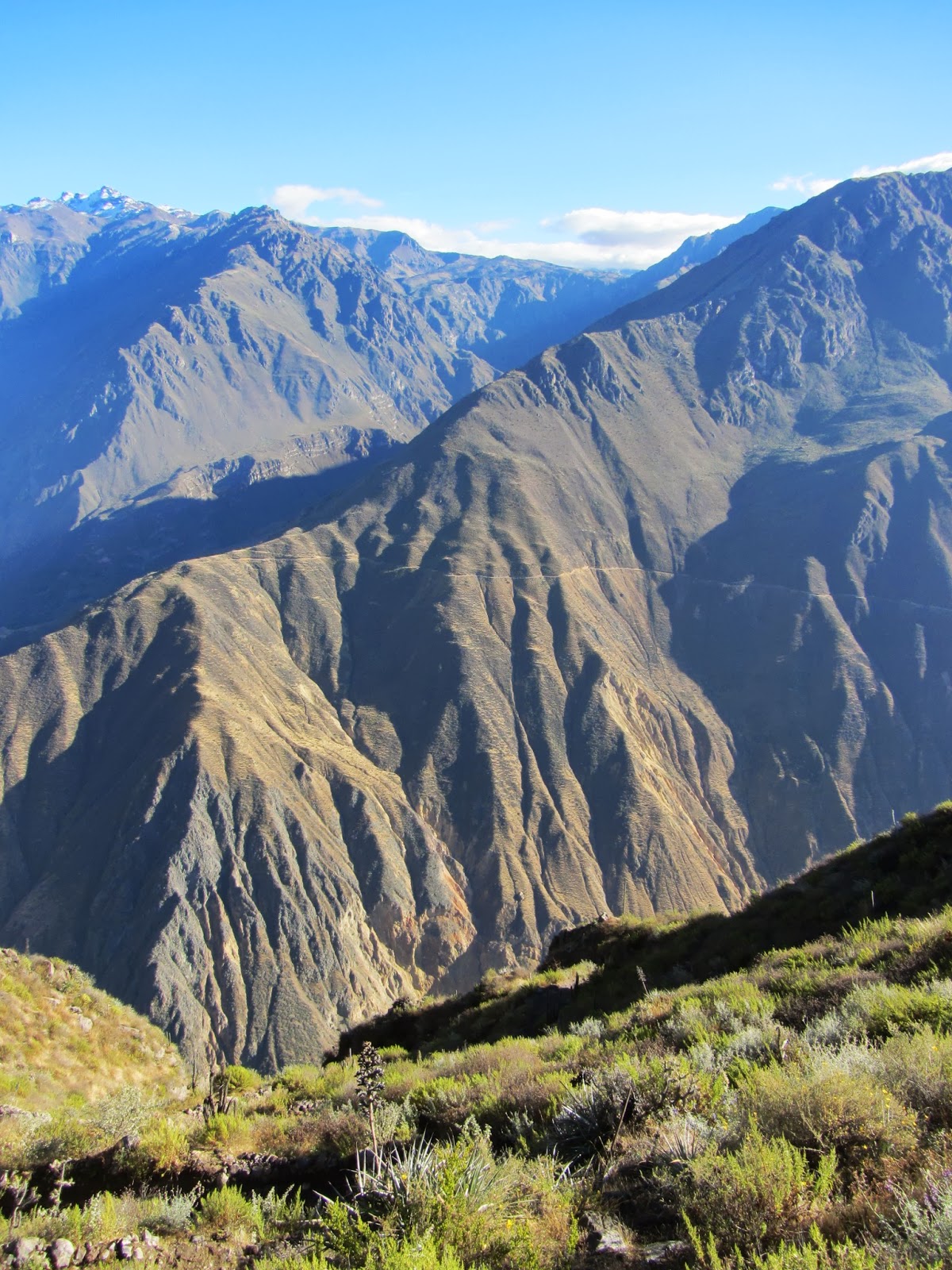
About a three hour drive outside of Arequipa, also known as the White City due to the sulphur from the surrounding volcanoes which has coated the city a whitish tinge, lies the second deepest canyon in the world, Colca Canyon. Apparently new readings are being taken worldwide of new and old canyons and their depths, one in Nepal was recently found and believed to be deeper than this one and the other one in Peru which is officially the deepest, but don't go telling the locals around here.
To get here, as always, there are two options: on your own or with a tour. On your own is easy enough, you need to take a bus to the township Cabanaconde close to the canyon's tourist entrance, or you can just do a tour. I opted for the tour as it made things easier and pretty much worked out as the same price as doing it on your own. Two day/ one night and three day/ two night tours are available but I went for the latter as I fancied taking my time and not rushing the walking part, as this would mean sacrificing time appreciating views and having downtime on the trail.
Pick up was at 3am and from the hostel it was a three hour drive to Chivay where the group on board the minibus was to have a simple breakfast, the usual fare of bread, butter and jam with tea or coffee. From here it was another hour and a half, about 80km, to Cruz del Condor, one of the core lookout points for condors. Unfortunately the weather was overcast and aside from the occasional break in the mist, the canyon and condors were not visible. The weather is supposed to be much clearer this time of year but a recent earthquake has been blamed for the recent poor weather, not sure I see the connection.
From here, it was only 15 minutes more to Cabanaconde and the start of the walking. The weather was still pretty dire and rain was threatening so after our guide introduced himself and we got familiar with the plan for the next three days, we started to make our way down. There were a few groups on the path and probably an even split of two day and three day tours.
From 3290m, the walk down was pretty dank, aside from seeing three young condors huddling on a rocky outcrop, the view didn't particularly improve as rain came in and apart from the opening half hour, everyone was in the rain for the remaining two and half hours of descent. By the time we reached the bridge at 2100m that lead to the municipality of Tapay and the village of San Juan for lunch, everyone was drenched.
At this stage, we had lunch and for us on the three day tour, our walking for the day was over and we were free to rest at our leisure. Seeing as how the weather was bad, this suited us just fine as we could just chill and catch up on sleep, a luxury considering how dorm rest is so often insufficient for so many reasons. This is also one of the reasons why I would recommend the three day tour, weather can be unpredictable and those doing the two day tour now had to walk a further 10km in the rain to get to their predestined rest stop, not my idea of a fun tour.
After an outrageously good nights sleep, we were up for a 0730 breakfast before setting off through the various villages which dotted the trail to our next stop, Sangalle, or more affectionately known as 'The Oasis'. Thankfully the weather had cleared and we could finally see the beautiful landscape and area we found ourselves in. The path was pretty steep and narrow for the first half hour or so and after a steep section we stopped to catch our breath and stock up on snacks and water as they're much more expensive in Sangalle.
The locals around here rely on pack horses and donkeys to traverse the same path we took yesterday to get supplies, but there is also a new road now that leads to the villages, only this takes six hours to get to Cabanaconde and has been built by a mining company as gold has been found in the local area. As with Bolivia, mining is a most lucrative and important business to cooparation's and locals keen enough to get involved.
The path continued to follow the curvature of the canyon until we reached an area known as Jarejna, this looked just like a crater but somehow on the side of the canyon wall. Incas used to use it for agriculture and the terraces formed all that time ago are still apparent but now it is used mainly as the site of a special annual World Cup where all the local villages register teams to play. This is a massive event each year, with everyone in the Tapay district turning up in their finest and a chance for the men in the area to impress the local ladies with their talents.
Once past this section, the path becomes much steeper, starts to zig zag and offers great views into the canyon and the days destination, Sangalle. From above, it really does look like an oasis. There is a natural spring close by and this has helped to cultivate a tropical feel deep in the canyon where there are palm trees everywhere, water from the spring filling swimming pools and individual huts for punters trekking through the canyon. An unexpected piece of paradise deep in the canyon.
Once down the path, everyone is able to take a plunge in the pools, relax and enjoy the rest of the day lounging in this unlikely place. Another reason I would recommend the three day trek is that if you do the two day trek you arrive here late in the evening as it is getting dark so you can't really take advantage of the pool and relax. Instead, you are pretty tired from 20km walking (in yesterday's case in the rain all day) and then you have to get up at the crack of dawn to climb out of the canyon.
Come 5am, everyone is packed and ready to head out of the canyon, no breakfast here, have to rely on having had sufficient food from the dinner and plenty of sleep, the latter not really being a problem, my appetite however causing me to be hungry all the time on this trip.
The walk itself isn't the most taxing, it's just long more than anything else. The path is again a zig zag pattern as opposed to a straight up incline, like day two of the Inca trail for example, so a slow and steady pace will see you gain the 1200m you originally descended in two and a half hours. At the top, Cabanaconde is in sight and a short walk through the local fields will take you to the village and breakfast.
Once eaten, the group is lead back to the minibus and taken to the look out point at Hangahuilca where you can get an even better perspective of how big the canyon is and how well the locals use the land, with terraces dotted across the canyon side everywhere. From here we were taken to Maca, an unassuming local village where they sell the usual Peruvian fare and then on to some underwhelming hot springs at Chacapi. By now I was somewhat hungry so our next destination at Chivay for an all you can eat buffet was more than appreciated, and as usual, I was completely unable to show any form of restraint.
From here the tour pretty much winds down and the driver takes you back towards Arequipa via an Andes mountain range viewpoint which includes views of the following volcanoes: Mismi, Hualca Hualca, Sabancaya, Ampato, Chachani, Misti, Ubinas and Chuchura. After this we drove along one of the main highways back to Arequipa which happens to go through a national park full of alpacas and llamas. By the early evening we arrived back at the Plaza de Armas in time for a quick shower and an onward bus to Lima.
To get here, as always, there are two options: on your own or with a tour. On your own is easy enough, you need to take a bus to the township Cabanaconde close to the canyon's tourist entrance, or you can just do a tour. I opted for the tour as it made things easier and pretty much worked out as the same price as doing it on your own. Two day/ one night and three day/ two night tours are available but I went for the latter as I fancied taking my time and not rushing the walking part, as this would mean sacrificing time appreciating views and having downtime on the trail.
Pick up was at 3am and from the hostel it was a three hour drive to Chivay where the group on board the minibus was to have a simple breakfast, the usual fare of bread, butter and jam with tea or coffee. From here it was another hour and a half, about 80km, to Cruz del Condor, one of the core lookout points for condors. Unfortunately the weather was overcast and aside from the occasional break in the mist, the canyon and condors were not visible. The weather is supposed to be much clearer this time of year but a recent earthquake has been blamed for the recent poor weather, not sure I see the connection.
From here, it was only 15 minutes more to Cabanaconde and the start of the walking. The weather was still pretty dire and rain was threatening so after our guide introduced himself and we got familiar with the plan for the next three days, we started to make our way down. There were a few groups on the path and probably an even split of two day and three day tours.
From 3290m, the walk down was pretty dank, aside from seeing three young condors huddling on a rocky outcrop, the view didn't particularly improve as rain came in and apart from the opening half hour, everyone was in the rain for the remaining two and half hours of descent. By the time we reached the bridge at 2100m that lead to the municipality of Tapay and the village of San Juan for lunch, everyone was drenched.
At this stage, we had lunch and for us on the three day tour, our walking for the day was over and we were free to rest at our leisure. Seeing as how the weather was bad, this suited us just fine as we could just chill and catch up on sleep, a luxury considering how dorm rest is so often insufficient for so many reasons. This is also one of the reasons why I would recommend the three day tour, weather can be unpredictable and those doing the two day tour now had to walk a further 10km in the rain to get to their predestined rest stop, not my idea of a fun tour.
After an outrageously good nights sleep, we were up for a 0730 breakfast before setting off through the various villages which dotted the trail to our next stop, Sangalle, or more affectionately known as 'The Oasis'. Thankfully the weather had cleared and we could finally see the beautiful landscape and area we found ourselves in. The path was pretty steep and narrow for the first half hour or so and after a steep section we stopped to catch our breath and stock up on snacks and water as they're much more expensive in Sangalle.
The locals around here rely on pack horses and donkeys to traverse the same path we took yesterday to get supplies, but there is also a new road now that leads to the villages, only this takes six hours to get to Cabanaconde and has been built by a mining company as gold has been found in the local area. As with Bolivia, mining is a most lucrative and important business to cooparation's and locals keen enough to get involved.
The path continued to follow the curvature of the canyon until we reached an area known as Jarejna, this looked just like a crater but somehow on the side of the canyon wall. Incas used to use it for agriculture and the terraces formed all that time ago are still apparent but now it is used mainly as the site of a special annual World Cup where all the local villages register teams to play. This is a massive event each year, with everyone in the Tapay district turning up in their finest and a chance for the men in the area to impress the local ladies with their talents.
Once past this section, the path becomes much steeper, starts to zig zag and offers great views into the canyon and the days destination, Sangalle. From above, it really does look like an oasis. There is a natural spring close by and this has helped to cultivate a tropical feel deep in the canyon where there are palm trees everywhere, water from the spring filling swimming pools and individual huts for punters trekking through the canyon. An unexpected piece of paradise deep in the canyon.
Once down the path, everyone is able to take a plunge in the pools, relax and enjoy the rest of the day lounging in this unlikely place. Another reason I would recommend the three day trek is that if you do the two day trek you arrive here late in the evening as it is getting dark so you can't really take advantage of the pool and relax. Instead, you are pretty tired from 20km walking (in yesterday's case in the rain all day) and then you have to get up at the crack of dawn to climb out of the canyon.
Come 5am, everyone is packed and ready to head out of the canyon, no breakfast here, have to rely on having had sufficient food from the dinner and plenty of sleep, the latter not really being a problem, my appetite however causing me to be hungry all the time on this trip.
The walk itself isn't the most taxing, it's just long more than anything else. The path is again a zig zag pattern as opposed to a straight up incline, like day two of the Inca trail for example, so a slow and steady pace will see you gain the 1200m you originally descended in two and a half hours. At the top, Cabanaconde is in sight and a short walk through the local fields will take you to the village and breakfast.
Once eaten, the group is lead back to the minibus and taken to the look out point at Hangahuilca where you can get an even better perspective of how big the canyon is and how well the locals use the land, with terraces dotted across the canyon side everywhere. From here we were taken to Maca, an unassuming local village where they sell the usual Peruvian fare and then on to some underwhelming hot springs at Chacapi. By now I was somewhat hungry so our next destination at Chivay for an all you can eat buffet was more than appreciated, and as usual, I was completely unable to show any form of restraint.
From here the tour pretty much winds down and the driver takes you back towards Arequipa via an Andes mountain range viewpoint which includes views of the following volcanoes: Mismi, Hualca Hualca, Sabancaya, Ampato, Chachani, Misti, Ubinas and Chuchura. After this we drove along one of the main highways back to Arequipa which happens to go through a national park full of alpacas and llamas. By the early evening we arrived back at the Plaza de Armas in time for a quick shower and an onward bus to Lima.
Labels:
Arequipa,
backpacker,
blog,
canyon,
Colca Canyon,
Grattan Maslin,
Peru,
solo,
South America,
travel blog
Subscribe to:
Posts (Atom)